 |
| It starts with an idea |
Introduction
An entrepreneur is person who starts up their own business; they are a person who takes the risk responsibility involved in undertaking a business venture as well as trying to make a profit. Successful entrepreneurs need a wide range of skills however some may not have the skills but they will have to employ employees who have these skills that are able to the job for them. There are many reasons for starting up a business but the main reasons that are commonly associated with business would be:
- A sense of personal achievement
- Personal freedom
- To generate greater return on invested capital and personal savings
- Employment
- The opportunity to generate and earn more money than an employer would pay in a salary
- Financial freedom
- The challenge
I am briefly going to look at the qualities of three entrepreneurs that my group studied and I will show a comparison between the two Andrew Carnegie, Walt Disney and particularly Bill Gates.


Andrew Carnegie
Carnegie can be said to have the drive to succeed he started working at a very young age and read books to improve his linguistic skill and as a method of self education.
- He performed exceptionally well in his job roles and was promoted quickly through the ranks
- Through his life while working he also invested sums into various businesses in order to generate more income which he did
- Furthermore he took interests in other industries looking for possible investment options or business opportunities that may arise
- He created his own company by purchasing companies that needed revitalising and adding them tighter with his own income generated from working and from his other investments he also borrowed money from his friend Thomas Scott to create the company with help from his other associates.
- He quickly grasped concepts and utilised them
- Was determined to succeed
- Hardworking
- He was an opportunist
- Strove to complete his education
- He was considered to be the richest man alive
- Philanthropic

Andrew Carnegie was born in Dunfermline, Scotland, on November 25, 1835, from an impoverished family, his father William B. Carnegie was a hand loom weaver and his mother, Margaret Morris, was daughter of Thomas Morris, a tanner and shoe maker, despite this he grew up in a cultured, political home. William Carnegie although poor was educated, he believed in education for his children and ensured to the best of his means that they were educated.
Carnegie was influenced greatly. His father and his uncles greatly influenced his life. In 1848 his family moved to the United State and settled in Allegheny, Pennsylvania. Carnegie entered the working world at the age of 13 where he started his first job as a bobbin boy in a cotton mill. After that at age 14 he got a job in the telegraph office where he earned $2.50 per week, there he caught the attention of Thomas Scott, superintendent of the Pennsylvania Railroad Company, who made Carnegie his private secretary and personal telegrapher in 1853. In 1859 he succeeded Scott as superintendent of Pittsburgh Railroad, while in this position he invested in various enterprises one being the Woodruff Sleeping Car Company and helped introduce the first successful sleeping car on American railroads, he also invested in the keystone bridge company, the Superior Rail Mill and Blast furnaces, the Union Iron Mills, and the Pittsburgh Locomotive Works. In 1861 using the money which he gained from his investment in the Woodruff Sleeping Car Company he invests $11,000 in an oil company in Titusville, Pennsylvania. He receives a return of $17,868 after one year. In 1863, Carnegie’s income is now a total of $42, 000 over half of which he gained from investments into oil, only $2400 contributed from his salary at the railroad. He also investment in other companies such as in the Piper and Schiffler Company, the Adams Express Company and the Central Transportation Company contributed $13,000.
In 1865 Carnegie retires from the railroad and with several associates from his other investments he reorganises the Piper and Schiffler Company to establish the Keystone Bridge Company. Their vision was to create bridges with iron instead of wood in order to make it more durable. Thomas Scott acted as one of the sources of capital and loaned Carnegie half of the $80,000 he needs for is investment. He then goes on and establishes Keystone Telegraph Company with his associates with the permission from the Pennsylvania Railroad to string up their wires across the rail poles. In 1868 Carnegie writes himself a letter which outlines his future plans which was to retire by the age of 35 and live on a fixed income of $35,000 and give off his remaining wealth to philanthropic causes and dedicate most of his time to his education. However his plans were assailed on a trip to England in 1872 where he visits Henry Bessemer’s steel plants, which one Carnegie’s iron company: The Freedom Iron Company had been using Bessemer’s process of making steel for several years. While in England Carnegie foresees the commercial potential of steel and returns to America with plans to expand his steel business, with this idea in mind Carnegie moved quickly, thus bringing about the creation of the Carnegie Steel Company.
Walt Disney
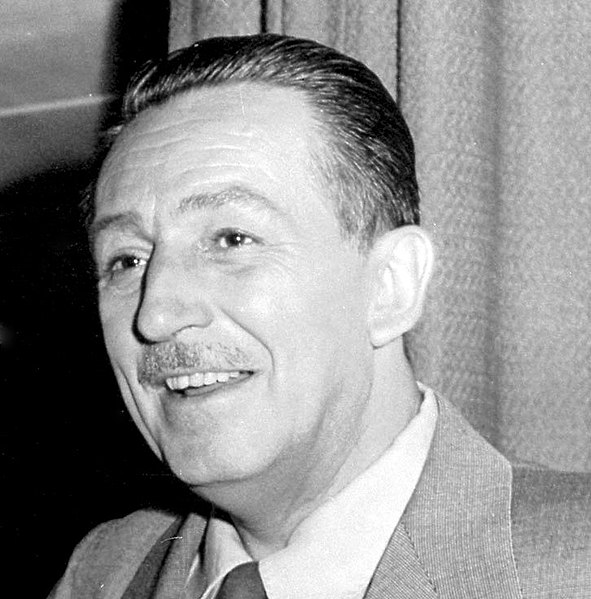
Walt Disney born in 1901 where his father moved from Canada to the United States as his father (Walk Disney grandparents) failed at farming. After Walt Disney’s birth the family moved to Marceline where Walt Disney improved his work of love for his drawings. Walt Disney earned some money drawing pictures of one of his neighbour’s horse. (The Disney family stayed in Marceline for four years then moved to Kansans City in 1910 where Walt Disney attended the Benton Grammar School where Walt Disney met Walter Pfeiffer who introduced him to vaudeville and motion pictures.)
Walt Disney started his freshman year at McKinley High School. While at high school he began taking night courses at the Chicago Art Institute and become the school papers cartoonist. The cartoon that he produced was on World War 1.
At the age of 16 Walt Disney dropped out of High school and try to join the army but failed as he was underage. After he got rejected, Walt Disney joint the Red Cross for one year where he drove an ambulance. After working for Red Cross Walt Disney’s brother helped him get a job in Pesmen-Rubin Art Studio, where Walt Disney created ads for newspapers, magazines, and movie theatres in Kansas.
While working at the Pesmen-Rubin Art Studio he met a person called Ubbe Iwerks who was a cartoonist, this is where he and Walt Disney become close friends and decided to open their own businesses. Within the 1920 Walt Disney and Ubbe Iwerks opened their company called Iwerks-Disney Commercial Artists however this company was taken over by Disney’s financial backers Winkler and Mintz.
Walt Disney's
- Walt Disney had a positive approach to risk-taking as his main mission was to create animation.
- Walt Disney had a positive attitude towards his drawing as he loved to draw.
- Walt Disney had to be able to solve problems with his business to be able to make the vision he saw come true.
- Walt Disney had adaptability as he didn't have any finance to start up his business.
- Walt Disney had a lot of flexibility as he tried to join the army.
- Disney then got the idea of turning his drawing into motion pictures.
- Walt Disney had a drive to create motion picture cartoons.


No comments:
Post a Comment